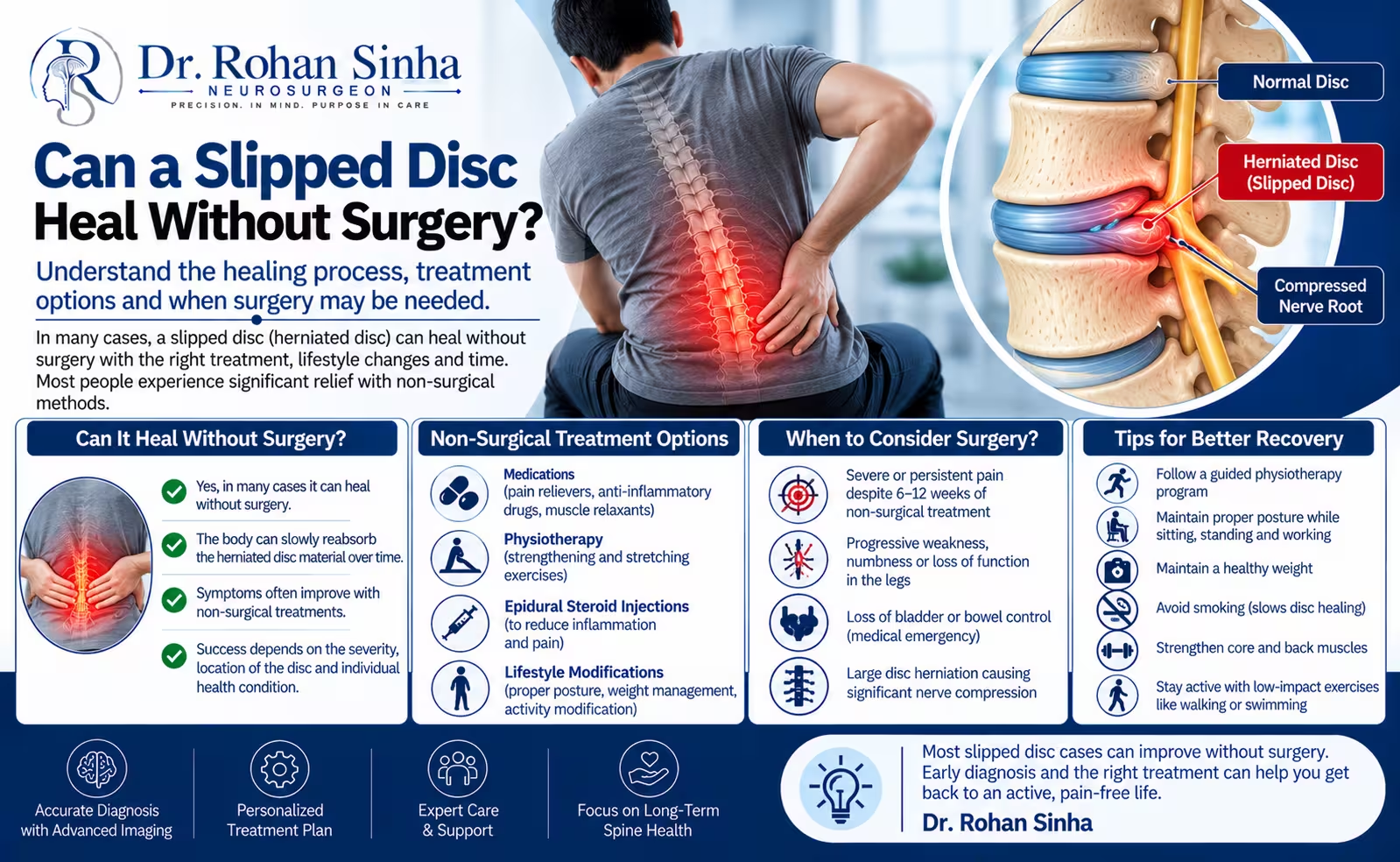
Yes, 90% of herniated discs heal without surgery within about 4 to 6 weeks. The body can naturally reduce inflammation, shrink the disc, or reabsorb the herniated portion over time.
Can a Slipped Disc Heal Without Surgery?
Certainly, a lot of cases of slipped or herniated discs may be resolved through nonsurgical means. This is true in the sense that most individuals usually recover using noninvasive therapy, especially where there is no neurological damage or muscle weakening.
A slipped disc is the condition whereby the gelatinous tissue inside a spinal disc protrudes outward through its deteriorated or torn exterior shell. This leads to pain, numbness or muscle weakness due to the irritated nerves. A herniated disc usually heals after four to six weeks without surgery.
Nevertheless, the healing process may differ from one individual to another depending on the nature of the disc problem, the degree of irritation of the nerves, among other factors.
What Is a Slipped or Herniated Disc?
The spinal column has soft cushions called discs between each vertebra.
In older age or due to repeated stress or an injury, the outer layer of the disc becomes weak. The inner layer of the disc presses outwards. This condition is popularly known as a herniated disc, slipped disc or disc bulge.
The condition occurs predominantly in the lower back and neck. A bulged disc in the lower back area causes nerve compression in the legs, whereas a bulged disc in the neck region causes nerve compression in the shoulder, arm, and hand.
What Are the Symptoms of a Herniated Disc?
This is contingent upon the location of the affected disc and whether the disc is putting pressure on a nerve.
Herniated Disc Symptoms in Lower Back
Symptoms could be any of the following:
- Back pain
- Pain that runs down to the buttock and/or leg
- Leg/foot tingling or numbness
- Muscle weakness
- Sciatica, which involves pain running the course of the sciatic nerve
Bulging Disc Symptoms in Neck
Symptoms of a neck disc problem could be:
- Neck pain or stiffness
- Pain radiating towards the shoulder or arm
- Arm/finger tingling or numbness
- Arm/hand muscle weakness
- Pain between the shoulder blades
It should be noted that not all bulges will exhibit symptoms. People can show changes on an MRI scan without feeling much pain.
How Can a Slipped Disc Be Treated Without Surgery?
If the symptoms can be managed and neurological complications are not present, physicians usually start with conservative therapy.
1. Changes in Lifestyle
One needs to refrain from activities like weightlifting and certain body positions that lead to aggravation of pain. Bed rest for an extended period of time is not usually advised since movement helps avoid stiffness.
2. Medications
Depending on the symptoms, one may receive medications that relieve pain and inflammation. Muscle relaxants may also be prescribed in some cases.
One has to follow the doctor’s recommendations concerning the use of medications, especially if a person suffers from other diseases or takes medications.
3. Physical Therapy
Physical therapy is a necessary procedure in treating the bulging disc for many patients. A physiotherapist can give you exercises that enhance your flexibility, muscle strength, and eliminate any additional stress on your back.
The exercises must be recommended based on your condition and not just random internet exercises.
4. Heat/Ice
Placing either heat or ice on the painful area may offer some temporary relief. It is up to your doctor or physiotherapist to decide whether you would benefit more from one or the other.
5. Spinal Injections
In case your pain doesn’t subside with these therapies, a specialist may suggest performing an epidural steroid injection or nerve block. This procedure can help you reduce inflammation around the irritated nerve.
Does Every Disc Bulge Need Treatment?
No. Just because there is a disc bulge in an MRI scan doesn’t always mean you should go for surgery.
Your treatment will depend on your symptoms and results of imaging studies and physical examination as well. In case the disc bulge is not giving you any major pain, you might only need to change your way of life and wait for improvement.
There are several treatment options for symptomatic patients including physical therapy, medication, injections and sometimes surgery.
It is crucial to understand that your MRI result should never be taken into account separately from your actual condition.
When Is Surgery Needed for a Slipped Disc?
Surgery is usually not the first method of treatment for a slipped disc. Nevertheless, it might be needed when the nonsurgical treatment does not help to relieve the problem.
When surgery is considered by a spine doctor:
- The pain is severe and cannot be managed by proper non-surgical treatment.
- The symptoms significantly affect the quality of life.
- Weakness of muscles is growing.
- Nerve compression occurs.
- Neurological complications are present.
In rare cases, severe nerve compression leads to problems with urination and bowel movements.
How Long Does a Slipped Disc Take to Heal?
The majority of individuals begin feeling an improvement within a few weeks. According to Cleveland Clinic, most herniated discs get healed on their own within four to six weeks. However, healing time may differ from individual to individual. There are some individuals who will get well soon, but there will also be some people who may take more time to heal and need further treatment.
If you feel that your pain is increasing or if there is any numbness along with pain, you should meet a spine specialist instead of waiting.
When Should You See a Spine Specialist?
You should seek medical evaluation if:
- Your back or neck pain is severe or persistent.
- Pain is travelling into your arm or leg.
- You have ongoing numbness or tingling.
- You develop muscle weakness.
- You have difficulty standing or walking.
- Symptoms are worsening instead of improving.
- You experience loss of bladder or bowel control.
Early assessment can help determine whether the symptoms are coming from a slipped disc or another spinal condition and whether conservative treatment is appropriate.
Why Choose Dr. Rohan Sinha?
Choosing the right treatment for a slipped disc begins with understanding the underlying cause of pain, numbness, or weakness. Dr. Rohan Sinha evaluates brain and spine conditions and helps patients understand suitable treatment options based on their symptoms and clinical findings.
Treatment planning may involve conservative management, appropriate investigations, and consideration of surgical options when clinically indicated. The goal is to identify the source of symptoms and recommend an approach suited to the patient's condition rather than assuming that every slipped disc requires surgery.
If you are looking for the Best Spine Specialist in Noida, a specialist evaluation can help determine whether non-surgical treatment is appropriate or whether further intervention should be considered.
Related Treatments
- Slip Disc Treatment
- Herniated Disc Treatment
- Back Pain Treatment
- Acute Low Back Pain Treatment
- Sciatica Treatment
- Endoscopic Disc Surgery
Conclusion
It is not necessary that a slipped disc requires surgical intervention. With proper non-surgical treatment such as a change in the level of activity, medication, physiotherapy, and at times injections, many patients improve. However, any pain, increasing numbness or weakness or even any issues with the bladder or bowel should not be overlooked. The treatment will depend upon the site and degree of involvement of the slipped disc and how it is affecting the nerves around it. In case you are suffering from any back or neck pain, you should visit Dr. Rohan, a leading spine surgeon in Noida.
Frequently Asked Questions
Can a slipped disc heal naturally?
Yes. Many slipped or herniated discs improve naturally or with nonsurgical treatment such as medicines, physical therapy and activity modification. Recovery commonly occurs within several weeks, although the exact time varies between individuals.
Are a bulging disc and a herniated disc the same?
No. While the former means that the disc is protruding outwards, in case of the latter, the disc material is known to push through a weak point on the outer portion.
When does a slipped disc need surgery?
In case of severe symptoms that don’t heal through proper nonsurgical treatment or progressive neurological impairment, surgery might be required. Urgent consultation is needed in case of incontinence, as it signals severe nerve compression.