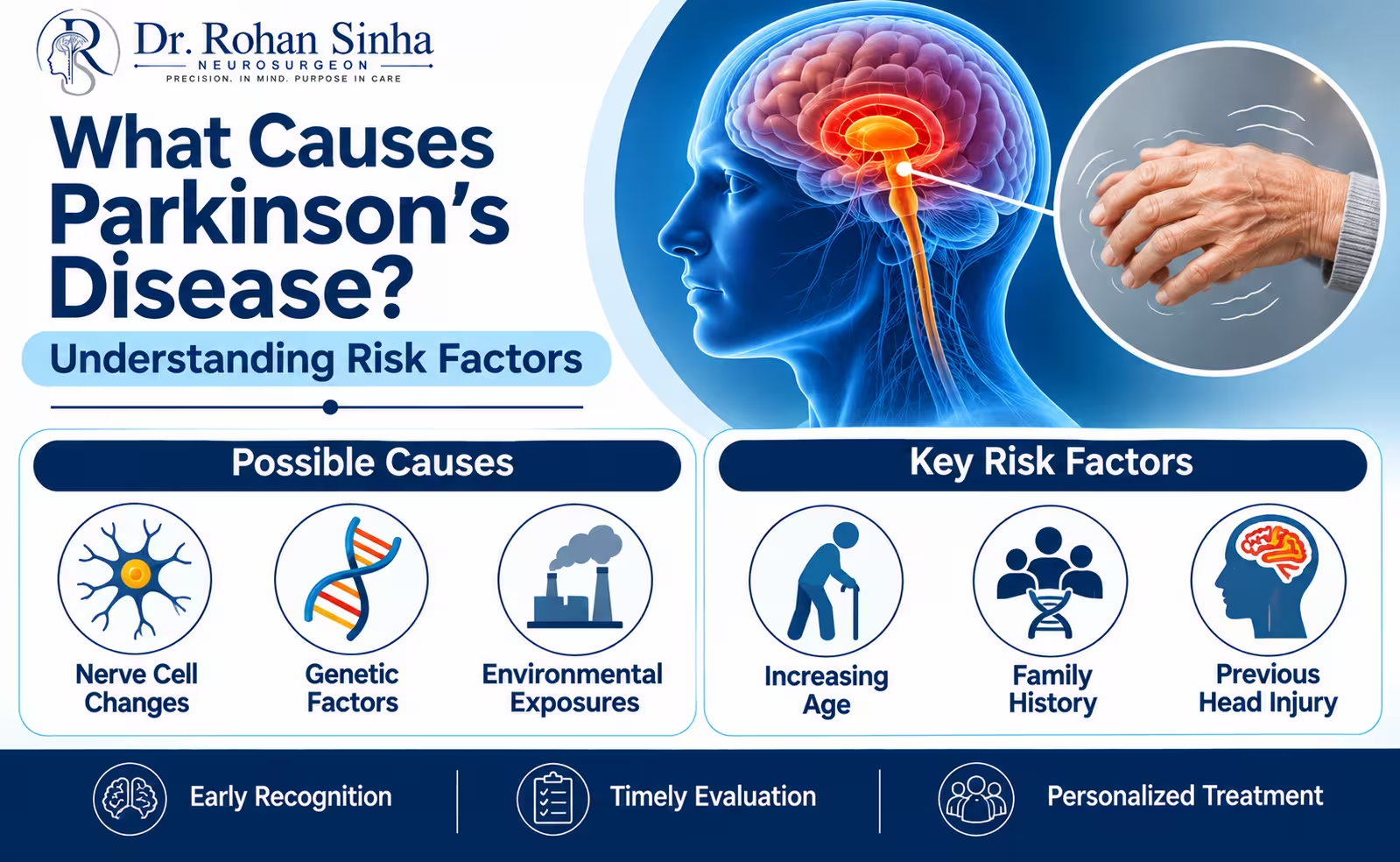
Parkinson's disease is caused by the progressive breakdown and death of nerve cells (neurons) in a region of the brain called the substantia nigra.
These specific neurons are responsible for producing dopamine, a chemical messenger that helps coordinate smooth and controlled body movements. When dopamine levels drop significantly—typically after 50% to 80% or more of these cells are lost—the brain can no longer control movement normally. Patients also lose norepinephrine, a chemical messenger that regulates automatic functions like blood pressure.
What Is Parkinson's Disease?
Parkinson's disease is a progressive disease of the nervous system that impacts the part of the brain that affects body movement. It develops through the gradual death or damage of nerve cells. Specifically, those that produce a chemical messenger called dopamine are affected.
Dopamine plays a role in assisting the brain in the formation of planned and controlled body movements. A decrease in dopamine levels causes slow and uncontrollable movements and leads to stiffness of the body. It also causes impairment of balance.
Symptoms usually appear gradually and may affect only one side of the body. Over time, these symptoms may increase and affect the other side of the body, as well as interfere with normal daily activities like eating and walking. Speech may become slurred.
What Causes Parkinson's Disease?
There isn't a single confirmed cause of Parkinson's. Researchers believe there may be multiple possible causes and that a combination of these factors may bring on the disease.
Some of the important changes related to Parkinson's disease include:
Breakdown of Dopamine-producing cells: Certain nerve cells in a brain region called substantia nigra gradually break down, and as a result, the level of dopamine in the brain decreases and movement is affected.
Genetic Changes: Certain variations of specific genes may increase the risk of developing Parkinson's. Most cases of Parkinson's are not inherited.
Environmental Factors: Long term exposure to pesticides and other chemical agents may be a risk factor for developing Parkinson's.
Abnormal Protein Deposits: Many individuals with Parkinson's have abnormal clumps of the protein alpha-synuclein, which are found in Lewy bodies.
There may be other factors as well. Researchers are working to determine how these changes occur and how they contribute to the development of Parkinson's.
What Are the Major Risk Factors for Parkinson's Disease?
While anyone can develop Parkinson’s, some factors may increase the chance of developing this condition. Having one or more risk factors does not mean a person will develop this condition.
1. Age
Age is perhaps the most important risk factor. Parkinson’s typically develops in people 50 years and older, and the risk increases with age.
Although Parkinson’s is uncommon in people younger than 50 years, it can and does occur. When symptoms begin before 50 years of age, it is generally referred to as early-onset Parkinson’s disease.
2. Family History and Genetics
Having a parent or sibling with Parkinson’s increases a person’s risk, as do certain genetic changes.
However, most people with Parkinson’s do not have a family member with the condition. In the vast majority of cases Parkinson’s is not inherited, and having a relative with Parkinson’s does not mean a person will get the condition.
3. Gender
There is some research to suggest there is a higher prevalence of Parkinson's in men as compared to women. There are many reasons for this that are still undiscovered. Research is being done to uncover the reason for the disparity using environmental, genetic, and hormonal factors.
4. Exposure to Pesticides and Chemicals
The use of pesticides, herbicides, and other environmental toxins may be contributing factors to the development of Parkinson’s. There has also been research done on the association between contaminated drinking water, and the development of Parkinson’s.
Being exposed to toxins does not mean that Parkinson’s will develop, and that is why research is being done to uncover the reason for the relationship.
5. Previous Head Injuries
There has been research to suggest that some forms of brain injuries can increase the risk of developing Parkinson’s. This research is still being explored. Not everyone who receives a brain injury will develop Parkinson’s.
What Are the Symptoms of Parkinson's Disease?
The symptoms of Parkinson's disease vary from person to person and can progress at different rates. For example, some people first notice slightly noticeable shaking in one hand, and others first notice they have difficulty with stiffness or changes with their walking pattern.
Some of the main symptoms are:
-
Tremor: Uncontrollable shaking, which usually starts in a hand and/or finger when that hand or finger is at rest.
-
Muscle Stiffness: Discomfort when trying to move a body part due to tightness in the muscle. This can happen in the arms and/or legs.
-
Slowness of Movement: Difficulty starting and/or completing everyday movements and activities, including getting up from a chair and/or walking.
-
Balance Problems: Having difficulty with standing and/or walking in a normal manner and/or changing direction.
Other, less obvious symptoms can include anxiety, depression, fatigue and other problems that can include sleep difficulties and loss of sense of smell as well as constipation.
How Is Parkinson's Disease Diagnosed?
There is no single test to confirm Parkinson’s disease. Generally, a diagnosis is made by taking a thorough history and performing a physical exam.
During the exam, the neurologist will check muscle stiffness, tremor, movement, reflexes and balance. These may vary depending on the symptoms and may require additional tests to rule out other conditions.
These tests may include:
-
MRI or CT Scan: To help identify other conditions of the brain that may cause similar symptoms.
-
Blood Tests: Help rule out other medical conditions that may effect movement.
-
DAT Scan: In certain cases to help assess brain dopamine related function.
Parkinson’s disease is a progressive disorder with a variety of motor symptoms. Early diagnosis helps the health care team to formulate the best method of symptom management.
Can Parkinson's Disease Be Prevented?
The reason that there is no definitive way to avoid Parkinson's disease is because the root causes of the disease are still unknown. However, there are lifestyle habits that may help protect overall brain health.
Some of these habits include:
-
Maintaining physical activity with exercise
-
Maintaining a balanced diet
-
Practicing pesticide and chemical exposure avoidance
-
Using proper stress and sleep management
-
Reporting to a doctor if an unusual tremor occurs
These habits, although not protecting against Parkinson's, help to build overall health.
Parkinson's Disease and Neurological Care: Consult Dr. Rohan Sinha
If you are looking for a Neurosurgeon in Noida, Dr. Rohan Sinha provides care for brain, spine, and neurological conditions. With 20+ years of experience in neurosurgery and spine surgery and 10,000+ patients treated, he evaluates complex neurological conditions and helps determine the most appropriate treatment approach based on each patient's individual condition.
Parkinson's disease affects people differently, and treatment decisions depend on symptoms, disease progression, and response to medical management. For selected patients who may require advanced treatment, a detailed evaluation can help determine whether specialized neurosurgical options may be appropriate.
Related Treatments
Conclusion
Parkinson's disease is the loss of dopamine producing brain cells. The causes of this loss are still undetermined. Factors that could contribute to an individual's risk are age, genetics, gender, and environment. Tremors, and muscular rigidity, with slowed or abnormal movements, may require an evaluation by a medical professional.
Currently there is no known cure to this condition. A doctor can help manage the symptoms to improve the quality of life. Any abnormal movements should be assessed by a medical professional. Dr. Rohan Sinha, is considered one of the best neurosurgeons and spine specialists in Noida, India. He can help assess your condition, and offer you the best treatment options available.
Frequently Asked Questions
1. What is the main cause of Parkinson’s disease?
It is still largely unknown what the cause of Parkinson’s is. It is thought to be caused by a loss of certain brain cells that create a chemical called dopamine. Genetic and environmental factors may play a role in causing this loss.
2. Can Parkinson’s disease be hereditary?
In some cases, it can be hereditary. Not all people with Parkinson’s have a family history of the disease. If a family member has Parkinson’s, it can increase your risk of developing the condition.
3. At what age does Parkinson’s disease usually start?
It can start at any age, but is most common over the age of 50. The older you are, the greater your risk of developing it is. Younger adults can also get it, but this is less common.
4. What are the first warning signs of Parkinson’s disease?
Early warning signs can be muscle stiffness, tremors, movement and cognitive decline, a reduction in smell, constipation and disturbed sleep. The symptoms typically begin gradually and may affect only one side of the body at first.
5. Can stress cause Parkinson’s disease?
Stress is not a cause of Parkinson’s, but it may make symptoms, including tremors and movement difficulties, worse.