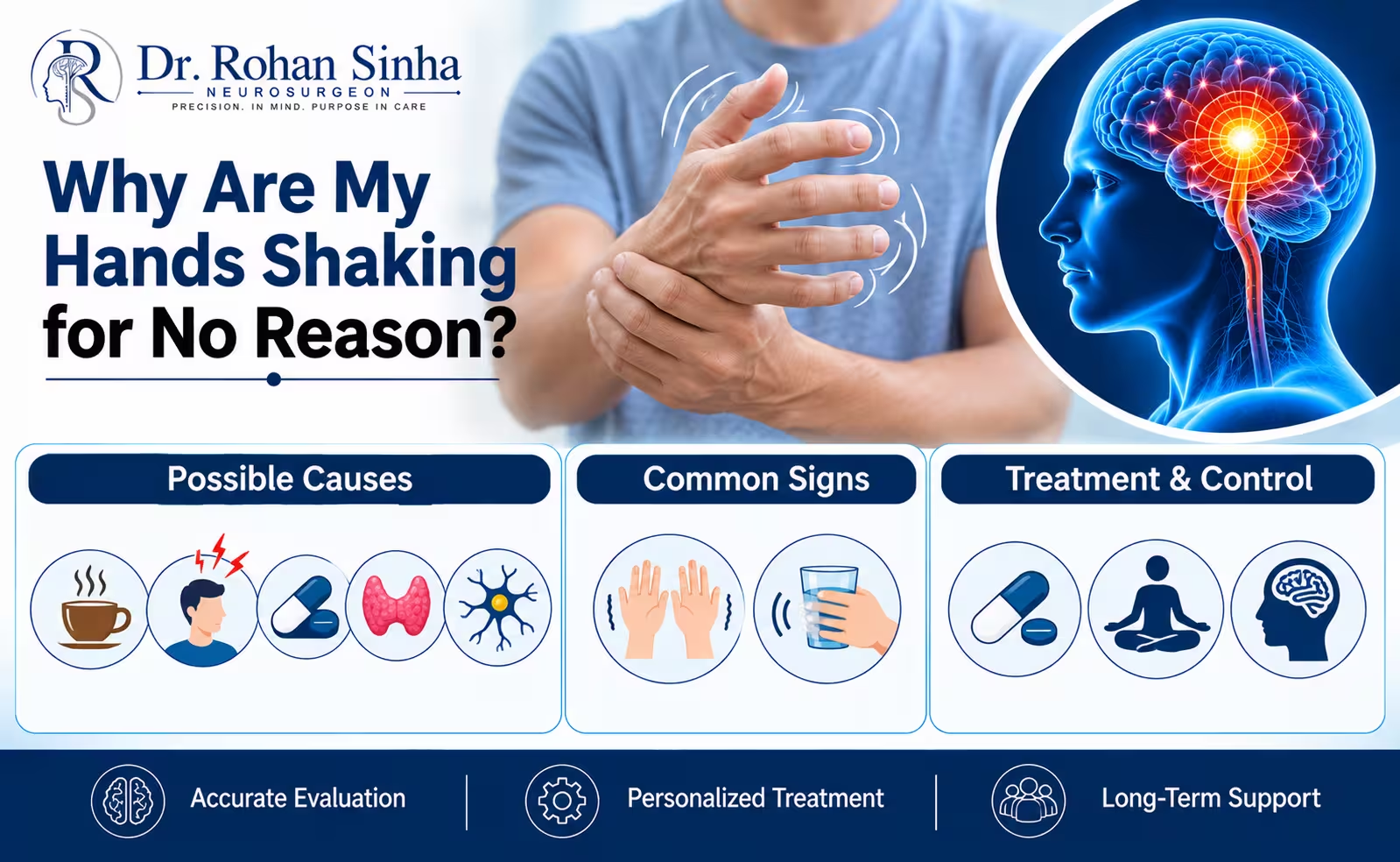
Hand shaking (tremors) often happens due to temporary, everyday triggers rather than a serious disease.
What Does It Mean When Your Hands Shake?
Hand shaking, also referred to medically as a tremor, involves the involuntary rhythmic movement of hands. It involves the contraction and relaxation of the muscles repetitively and involuntarily.
Hand shaking to some extent is normal in healthy people. However, there are certain conditions that may increase the likelihood of noticing the shaking of hands.
Tremor in the hand can be broadly categorized into two major categories.
-
Rest tremor: This involves hand shaking when the hands are at rest such as when placed on the thighs.
-
Action tremor: This involves shaking of hands during action of movement of the hands and when holding them in a specific posture, for instance, when writing.
The type of hand shaking, timing of the tremor, and unilaterality of the tremor may indicate its cause.
Why Are My Hands Shaking for No Reason? Common Causes
There are a number of possible causes for frequent observation of shaking hands, of both the physical and neurological kinds as well as from lifestyle.
Some causes include:
1. Stress and Anxiety
Hand tremors due to anxiety and stress are typically temporary. The body’s fight-or-flight response is triggered by the release of stress hormones like adrenaline. Symptoms like shaking hands may occur right before an important meeting or during a stressful or threatening situation.
Anxiety tremors may occur with:
-
Increased heartbeat
-
Sweating
-
Feeling nervous or overwhelmed
-
Restlessness
-
Rapid breathing
Some people may feel anxious about having shaking hands and these feelings may make the tremors worse. In most cases, relaxing can lessen the tremors.
2. Caffeine
Excessive consumption of caffeinated drinks like coffee, tea, energy drinks, etc. may stimulate the nervous system which can make your hands shake. Tremors can occur with anxiety from caffeine consumption, even at moderate levels.
Reducing your caffeine consumption may be useful to stop shaking hands.
3. Hypoglycemia
Hypoglycemia or low blood sugar, is one possible cause of hand tremors. It happens more frequently in patients with diabetes and takes place when they are using certain medication or insulin.
Adrenaline gets released when there is insufficient glucose in the bloodstream, resulting in shakiness.
Additional signs may include:
-
Sweating
-
Feeling hungry
-
Feeling dizzy
-
Rapid heartbeats
-
Mental confusion
-
Fatigue
In serious cases of hypoglycemia, immediate action is required.
4. Essential Tremor
Essential tremor is a neurological condition where the individual involuntarily shakes, most often in the hands and the arms.
It may affect individuals at any age and may have a familial history as well.
The tremors mostly manifest themselves in actions such as writing, drinking from a cup, eating, or even while holding an object.
It should be noted that as compared to Parkinson's tremors, these tremors are not visible when the hands are at complete rest but when they are moving.
Even though it is rarely life-threatening, the severe ones do disrupt everyday activities.
5. Parkinson's Disease
Parkinson's disease is a condition where brain cells that control movement gradually deteriorate.
One of the symptoms is a resting tremor. With this, the arms or hands may shake when in a relaxed position.
Others may include:
-
Slow movement
-
Muscle rigidity
-
Lack of balance
-
Change in walking pattern
-
Shrinking handwriting
Tremors, along with other movement-related symptoms, are characteristic of Parkinson's disease and should be further evaluated by a neurologist.
6. Overactive Thyroid
The thyroid gland is responsible for making thyroid hormones which regulate metabolism. With an overactive thyroid gland, too much thyroid hormone is produced and hyperthyroidism occurs.
The nervous system is also affected, causing fine shaking of the hands.
Others may include excessive sweating, unexpected weight loss, a fast and irregular heartbeat, restlessness and feeling weak due to lack of sleep.
7. Lack of Sleep and Physical Fatigue
Muscle function and the operation of the nervous system can be negatively impacted by fatigue. Prolonged physical activity can cause your hands to become shaky and this can be exacerbated by a lack of adequate rest.
In the case of fatigue or lack of adequate rest, shaking can be reduced through proper rest and hydration.
8. Medications
Certain prescription medications can cause tremors of the hands as a side effect. Some of these medications include:
-
Certain antidepressants
-
Asthma medications
-
Epilepsy medications
-
Medications for psychiatric conditions
-
Heart medications
In the case of a new prescription or adjustment of dosage causing your hands to shake, contact your doctor to discuss. Never adjust your prescription medications on your own.
9. Multiple Sclerosis
Multiple Sclerosis is a condition where the protective covering of the nerves of the brain and spinal cord is attacked by the body’s own immune system. This attack can interrupt the brain’s communication with the rest of the body.
Tremors occur with MS when attempts are made at controlled movements.
Other symptoms include: muscle weakness, vision problems, numbness and issues with body coordination.
How Are Hand Tremors Diagnosed?
Your doctor will take into account your symptoms and your history and condition in order to determine the reason as to why your hands are shaking.
The following tests may be suggested:
-
Blood tests: To investigate blood sugar level, thyroid function, as well as other possible metabolic issues.
-
Neurological examination: To evaluate muscle strength and speed, movement and reflexes.
-
MRI or CT scan: To identify different abnormalities of the brain, if clinically necessary.
-
EMG or nerve conduction studies: To evaluate the function of muscles and nerves.
Generally not everyone will require all of the above-mentioned tests. The doctor will suggest tests based on the suspected cause.
Treatment Options for Shaking Hands
Treatment depends on the type of tremor, its severity, and the underlying medical condition.
Some commonly used treatment options include:
-
Medications: Doctors may prescribe medicines such as propranolol or primidone for certain types of essential tremor.
-
Lifestyle changes: Reducing caffeine, managing stress, and improving sleep may help control mild tremors.
-
Physical and occupational therapy: These therapies can improve coordination, muscle control, and the ability to perform daily activities.
-
Botox injections: In selected cases, botulinum toxin injections may help manage certain types of tremors.
-
Deep Brain Stimulation (DBS): For severe tremors that do not respond adequately to medication, a neurologist or functional neurosurgeon may consider this procedure. It involves placing electrodes in specific areas of the brain to regulate abnormal movement signals.
The treatment plan should always be based on an accurate diagnosis rather than simply trying to suppress the shaking.
When Should You See a Doctor for Shaking Hands?
Mild and occasional hand shaking is nothing to be worried about. See a doctor, however, if:
-
Your hands shake a lot and for no obvious reason.
-
Tremors continue to increase and become noticeable to others.
-
You find it hard to write or eat because of your tremors.
-
There is muscle stiffness or weakness along with the shaking.
-
There is difficulty walking and maintaining balance.
-
Tremors occur after taking a new medication and they do not improve with time.
There is sudden shaking on one side of the body along with weakness, facial drooping and difficulty speaking and/or seeing. This may be a sign of stroke.
Shaking Hands or Tremors: Consult Dr. Rohan Sinha
If you are looking for a Neurosurgeon in Noida, Dr. Rohan Sinha provides care for brain, spine, and neurological conditions. He has 20+ years of experience in neurosurgery and spine surgery and has treated 10,000+ patients. Persistent hand tremors can have different causes, and understanding the pattern of shaking and associated symptoms is important for proper evaluation. Dr. Rohan Sinha assesses neurological symptoms and helps determine whether further investigations or specialized treatment may be required. If your hand shaking is persistent, worsening, or affecting your daily activities, timely medical consultation can help identify the underlying cause and guide the next steps.
Related Treatments
Conclusion
Hand tremors have many possible causes, including stress and anxiety, caffeine use, low blood sugar, essential tremor, Parkinson’s disease, and other neurological conditions.
Shaking can often resolve on its own with rest, but persistent shaking can’t be taken to mean that there is no reason to be concerned. Tremors that happen over and over again should be assessed to determine the cause. If the cause of the tremor is not addressed, it can potentially lead to other health issues.
If you are having unexplained shaking of the hands or are having issues controlling the movements of your hands, you should make an appointment to see Dr. Rohan Sinha as soon as possible. Dr. Sinha is a neurosurgeon and a spine specialist in Noida.
Frequently Asked Questions
1. Why do my hands shake even when I am not nervous?
Many factors can cause hand shaking other than anxiety. Caffeine, low blood sugar, thyroid problems or essential tremor can all be causes. If it happens often, see your doctor so they can check for the cause.
2. Can vitamin deficiency cause hand tremors?
Nerve and muscle functions can be affected by certain nutritional deficiencies. Vitamin B12 deficiency can cause neurological problems, but it is usually not the cause of hand tremors. To be sure, lab work can be done.
3. Can shaking hands be a sign of Parkinson's disease?
Yes, hand tremors can be a sign of Parkinson's disease and can even occur before other signs of the disease. They usually occur when the hands are at rest and may occur on just one side. Hand tremors do not always mean a person has Parkinson's disease.
4. How can I stop my hands from shaking naturally?
It can help to limit caffeine, get enough sleep or relax if tremors are due to anxiety, stress or fatigue. If tremors don't go away, see your doctor to find out what is causing them.
5. Are hand tremors a serious neurological problem?
Hand tremors can be a sign of serious problems, like a neurological condition, but not always. Temporary tremors can be completely harmless. See your doctor if tremors happen often, get worse or happen suddenly.