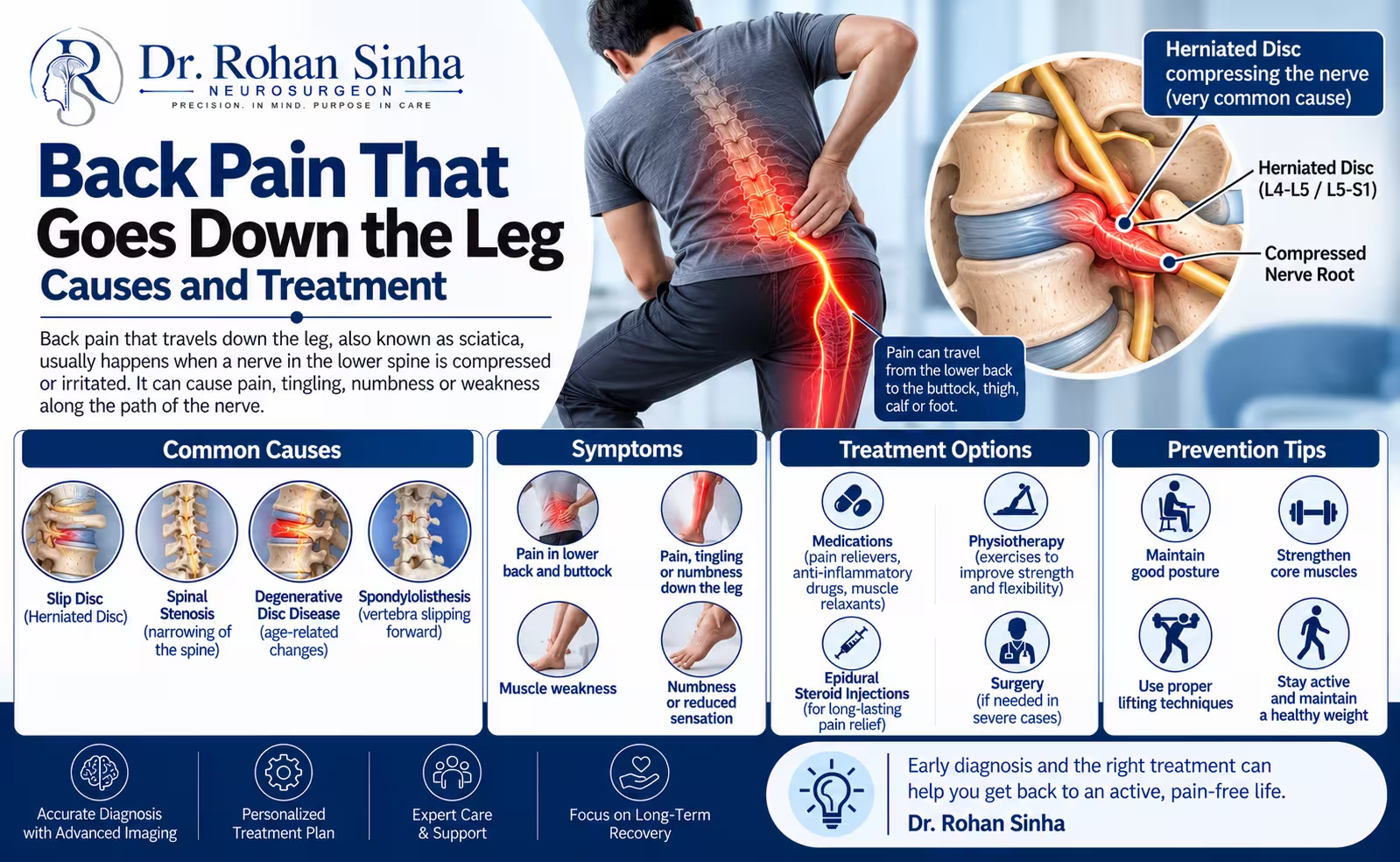
Back pain radiating to the leg is often caused by Sciatica, which happens when a spinal issue irritates or compresses the sciatic nerve.
Why Does Back Pain Go Down the Leg?
The lower back contains nerves that travel toward the legs. When a nerve root becomes irritated or compressed, pain can follow the nerve pathway from the lower back or buttock into the leg.
This can happen because of:
-
Slipped or herniated disc
-
Sciatica
-
Spinal stenosis
-
Lumbar spondylosis
-
Other conditions causing nerve compression
Common Causes of Back Pain That Travels Down the Leg
1. Sciatica
Sciatica occurs when the sciatic nerve or its contributing nerve roots become irritated or compressed. Pain may begin in the lower back or buttock and travel into the leg.
It may be associated with:
-
Shooting or burning pain
-
Tingling
-
Numbness
-
Leg weakness
2. Slipped or Herniated Disc
A slipped disc can press on a nearby nerve and cause back pain along with pain, numbness, or tingling in the leg.
In some cases, symptoms can extend down toward the foot depending on which nerve is affected.
3. Spinal Stenosis
Spinal stenosis occurs when the space around the spinal nerves becomes narrower. This may cause pain, numbness, or weakness in the legs.
Some people notice that symptoms become worse while standing or walking and improve when sitting or bending forward.
4. Lumbar Spondylosis
Age-related changes in the lumbar spine can sometimes contribute to back pain and nerve irritation. However, an abnormality seen on an X-ray or MRI does not necessarily mean it is the cause of symptoms.
What Does Nerve-Related Leg Pain Feel Like?
Pain caused by nerve irritation may feel different from ordinary muscular pain.
You may experience:
-
Sharp or shooting pain
-
Burning sensation
-
Tingling or pins and needles
-
Numbness
-
Weakness in the leg or foot
-
Pain that worsens with certain movements
The exact symptoms depend on which nerve is affected.
When Should You See a Doctor?
Back pain that goes down the leg does not always mean that surgery is required. Many patients improve with appropriate non-surgical treatment.
However, you should seek medical evaluation if:
-
Pain persists or keeps returning
-
Pain is interfering with daily activities
-
You have persistent numbness or tingling
-
Your leg or foot feels weak
-
Symptoms are getting worse
Progressive weakness is particularly important because it can indicate significant nerve involvement.
Emergency Warning Signs
Seek urgent medical attention if back or leg pain is accompanied by:
-
New difficulty passing urine
-
Loss of bladder or bowel control
-
Numbness around the groin or genital area
-
Severe or rapidly worsening weakness in the legs
-
Major difficulty walking
These symptoms can indicate severe nerve compression and require urgent assessment.
How Is the Cause Diagnosed?
Diagnosis usually starts with a detailed medical history and physical examination.
A doctor may assess:
-
Where the pain starts and where it travels
-
Muscle strength
-
Reflexes
-
Sensation
-
Walking and coordination
-
Presence of numbness or weakness
An MRI may be recommended in selected cases when imaging is likely to influence treatment decisions. Routine imaging is not required for every person with back or leg pain.
Treatment Options for Back Pain That Goes Down the Leg
Treatment depends on the underlying cause and severity of symptoms.
Exercise and Physiotherapy
Appropriate exercise and physiotherapy may help improve movement, strength, and function. Staying reasonably active is generally preferred to prolonged bed rest in uncomplicated cases.
Medicines
Depending on the condition and medical history, a doctor may recommend medicines to manage pain or inflammation.
Regular self-medication should be avoided, especially when symptoms are persistent.
Treatment for the Underlying Cause
If the pain is caused by a slipped disc, herniated disc, spinal stenosis, or another spinal condition, treatment should address the underlying problem.
Surgery in Selected Cases
Most cases do not automatically require surgery.
Surgery may be considered when symptoms remain severe despite appropriate non-surgical treatment, when there is significant nerve compression, or when progressive neurological weakness develops. For selected patients with sciatica, spinal decompression may be considered when non-surgical treatment has not improved pain or function and imaging findings match the symptoms.
Can Back Pain Going Down the Leg Improve Without Surgery?
Yes. Many patients with sciatica or disc-related nerve irritation improve with non-surgical care.
Depending on the condition, treatment may include:
-
Appropriate activity
-
Exercise-based treatment
-
Physiotherapy
-
Medical pain management
-
Specialist follow-up
If symptoms persist or worsen, the diagnosis and treatment plan may need to be reassessed.
Why Choose Dr. Rohan Sinha for Spine Care in Noida?
Back pain that travels down the leg can have several causes, including sciatica, slipped disc, herniated disc, and spinal stenosis. Identifying the underlying cause is important for choosing the right treatment. Dr. Rohan Sinha, Best Neurosurgeon & Spine Specialist in Noida, provides specialized care for spine and neurological conditions with an emphasis on individualized assessment and treatment planning.
Dr. Rohan Sinha evaluates symptoms, neurological findings, medical history, and relevant imaging to understand whether the pain is related to nerve compression or another spinal condition and to determine an appropriate treatment approach.
If back pain is persistent, travels into the leg, or is associated with numbness, tingling, or weakness, timely specialist evaluation can help guide the next steps.
Related Treatments
Related Articles
- Brain Tumour Warning Signs: Symptoms That Need Medical Evaluation
- Lower Back Pain: Common Causes and Treatment Options
- Brain Tumor Symptoms: 10 Early Warning Signs
- When Does a Brain Tumor Require Surgery?
- L4-L5 Slip Disc: Symptoms and Treatment Options
Conclusion
Back pain that goes down the leg can be caused by nerve irritation or compression, with sciatica, slipped or herniated discs, spinal stenosis, and lumbar spinal changes among the possible causes.
The pain may be accompanied by tingling, numbness, burning sensations, or weakness. Many patients improve with non-surgical treatment, but persistent or worsening symptoms should be medically evaluated.
Back pain with bladder or bowel problems, numbness around the groin area, or rapidly worsening leg weakness requires urgent medical attention.
Frequently Asked Questions
1. Why does my back pain travel down my leg?
Pain may travel down the leg when a nerve in the lower back is irritated or compressed. Sciatica and herniated discs are common causes.
2. Is leg pain always sciatica?
No. Sciatica is one possible cause. Spinal stenosis, disc problems, and other spinal conditions can also cause radiating leg pain.
3. Can a slipped disc cause leg pain?
Yes. A slipped or herniated disc can irritate a nearby nerve and cause pain, tingling, numbness, or weakness in the leg.
4. Does back pain going down the leg always require surgery?
No. Many patients improve with non-surgical treatment. Surgery is considered only in selected cases based on symptoms, neurological findings, and response to treatment.
5. When should I get an MRI?
MRI is not required for every case. It may be considered when symptoms or examination findings suggest a specific spinal problem and imaging is likely to change treatment.
6. When is radiating leg pain an emergency?
Seek urgent medical attention if you develop bladder or bowel problems, numbness around the groin area, or severe or rapidly worsening weakness in the legs.